Unfortunately I can't take credit for coming up with this design. I came across it at http://hem.passagen.se/hemipanter/ while researching different suspension designs. I was originally looking to put a SLA in my Mustang when I learned about the Locost.
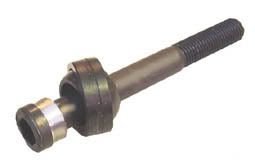
The upper ball joint was custom made from a spherical bearing and a block of aluminum and the lower ball joint is a late 80' to early 90's Saab unit. As far as the hubs they are very easy to find. The local wrecking yard has close to 60 Malibu’s. I can't comment on the weight yet as I am still in the planning stages. The design should allow for minimal KPI with low to zero scrub. Best of all is only minimal welding is needed or you could make the steering arm and brake caliper adapter bolt on.
Wow, fascinating topic. My head hurts from picturing 3D geometry now. That being said, I have some questions:
Why does the Corvette steering feel so numb, but the Miata's feels fairly lively? Is it because the Corvette has a small KPI vs a large caster, while the Miata has a large separation between the two? Is it scrub angle? Is it toe and static camber angles? I'd love to see the Solstice and STi (numb) and the Evo (lively) suspension numbers added to that comparison.
I can answer some of the questions above. Static toe and camber angles only do so much. I autocross and Solstice and with a dedicated autocross alignment on it, the steering still feels numb. My Evo definitely does some of the things that people talk about in here, like steering into puddles, tramlining on ruts in the pavement, and just being really high-strung on the highway. Does it have close to zero scrub radius and is that why it does that stuff?
From a tire standpoint, at least for racing I can tell you what the goal of a good suspension is: keep the right amount of absolute camber in the tire througout the steering range. By absolute camber I mean the angle of the tire from the ground. This means the combination of caster, KPI, and camber gain should exactly counteract the camber loss from body roll. In the real world this doesn't happen, and without a system that can actively adjust camber it can never happen (think about steering angle vs. g-force at different speeds and you'll see why), but its a good goal.
I would think the most important thing KPI does for a suspension's performance is the jacking effect. By jacking the outside front tire, you're increasing the weight differential on the front tires while decreasing it on the rear tires, sort of like a dynamic wedge adjustment.
I would think the most important thing KPI does for a suspension's performance is the jacking effect.
I'm not sure about that. When you turn the front wheel, both of them have this effect so it isn't just the outside wheel. Once the car is cornering, I don't think their is enough jacking to make a difference. It seems like it would be a small percentage of the body roll, so a much smaller effect then an anti-roll bar for example.
exactly counteract the camber loss from body roll. In the real world this doesn't happen, and without a system that can actively adjust camber it can never happen (think about steering angle vs. g-force at different speeds and you'll see why),
There are compromises and what one hand giveth the other takes away. I think the good example is braking verses cornering. It is possible to do what you mention in the case above, you could easily over correct. So that as you corner the front wheel would go from too little camber to too much (negative). For instance if you used a really short upper wishbone. That will really hurt straight line braking though.
Puk wrote:This is a quick sketch of a "universal" upright that I've been toying with, a single design for all 4 corners. It is designed around:
Bolt on hub (Ford Mondeo) Bolt on ball joints (GM Chevette / Austin Maxi / VW Golf) Track rod end and upper ball joint in same plane to remove bump steer Track rod end and upper ball joint mount on a demountable arm, with shim(s) sandwiched between it and the upright allowing camber changes without upsetting tracking (Porsche 962 design) Upright from steel rectangular hollow section
Lets see if the image shows up:
bah, make it out of billet
(that is if you havent already made them in the year or so after that post)
Unfortunately I only have 1 testing day on the car so I do not have a lot of data but I did get a good baseline feel for everything.
The good news is it did not do anything bad and the shoulder wear (at least on the side that had the correct -1* of camber thanks to my failed attempt to compensate for an uneven garage floor) was unnoticeable. I did not get a chance to take any pyrometer readings to verify tire pressure and camber settings this outing so I am relying solely on wear at this point.
The steering feel seemed pretty much perfect - it was not too heavy but there was enough feedback to allow you to feel what the front of the car is doing. Most importantly it was quick enough to navigate through tight turns.
So to answer your question, the initial testing looked promising.
You mention steering feel, which I know is somewhat of a subjective thing but I wondered if you would share your steering arm length, rack ratio, and steering wheel diameter. (And anything else you think is relevant that I'm leaving out, like maybe tire size?)
Steering feel seems like one of those elusive attributes that it would be nice to catalog everyone's experience to try to distill it down, see if any patterns emerge, ratios of certain parameters, etc. New thread?
Puk wrote:Sorry Horizonjob - that rectangular section should read hollow section. I'll edit the original post to reflect that.
The same design would be used on all four corners - as the Lotus Elise design.
On the chassis front I'm taking inspiration from an old Lotus design - Formula Lotus. It wasn't really a monocoque but a twin spar, each side being aluminum honey comb "plank". I built a few when I was a student on a year out from college. Once I've got a chassis sketched out I'll start a new thread to try and harvest the collective knowledge. Weight wise it was similar to the comparable Formula Ford steel space frame chassis, but much easier to build (no welding). The Formula Lotus chassis developed a reputation for being a great car to crash in.
The major elements of the chassis were bolted together, not bonded, but there are now structural adhesives that cure at room temp and are tolerant of less than perfectly clean surfaces. Hence my interest in that area.
Cheers, James
OK ok, I know old thread dig BUT....
Does anyone know of these 'Formula Lotus' PUK speaks of which have honeycomb plank chassis? Would love to see a few examples of these, but google is no help. Also, where would one buy said honeycomb planks?
Puk wrote:Sorry Horizonjob - that rectangular section should read hollow section. I'll edit the original post to reflect that.
The same design would be used on all four corners - as the Lotus Elise design.
On the chassis front I'm taking inspiration from an old Lotus design - Formula Lotus. It wasn't really a monocoque but a twin spar, each side being aluminum honey comb "plank". I built a few when I was a student on a year out from college. Once I've got a chassis sketched out I'll start a new thread to try and harvest the collective knowledge. Weight wise it was similar to the comparable Formula Ford steel space frame chassis, but much easier to build (no welding). The Formula Lotus chassis developed a reputation for being a great car to crash in.
The major elements of the chassis were bolted together, not bonded, but there are now structural adhesives that cure at room temp and are tolerant of less than perfectly clean surfaces. Hence my interest in that area.
Cheers, James
OK ok, I know old thread dig BUT....
Does anyone know of these 'Formula Lotus' PUK speaks of which have honeycomb plank chassis? Would love to see a few examples of these, but google is no help. Also, where would one buy said honeycomb planks?